A broken, spam-filled restoration site, rebuilt to rank and pay for itself.
Restoration Professionals handles water, fire, and mould damage across the GTA - high-ticket, high-stress, high-intent work. They came to us with a website that was broken, full of spam, and barely ranking. We rebuilt it. The climb since has been steady rather than spiky: from around 20 search impressions a day at launch to more than 700, at a 5 to 10 percent click-through rate, while a roughly $1,500 monthly Google Ads budget returns 15 to 20 booked jobs.
Scope of WorkIn short
Restoration Professionals came to Meison with a broken, spam-filled site that did not rank. We rebuilt it. Google Search Console impressions grew from about 20 a day at launch to over 700, at a 5 to 10 percent click-through rate, and a roughly $1,500 monthly Google Ads budget now returns 15 to 20 booked restoration jobs a month.
We inherited a site that was working against them
Before the rebuild, the website was broken in the ways that quietly cost a restoration company money: spammy pages that should never have existed, a structure Google could not make sense of, and almost no ranking to show for years of being in business. In an emergency category, an underperforming site is not a missed opportunity - it is jobs going to whoever shows up first. So the first job was demolition. Strip the spam, fix what was broken, and rebuild on a foundation search engines could actually read.
The growth is a line, not a spike, and that is the point
At launch the new site was doing about 20 search impressions a day. It is now over 700, and the shape of that climb matters as much as the number. It went up steadily, month after month, instead of spiking and crashing. A near-vertical jump followed by a cliff is the signature of scaled, low-quality content, and it is the exact pattern Google is built to catch. A steady line is what durable, earned ranking looks like. The click-through rate sits between 5 and 10 percent, which is strong for work this expensive, because the listings match what a homeowner in a genuine emergency is actually searching for.


The page has one job: convert someone standing in water
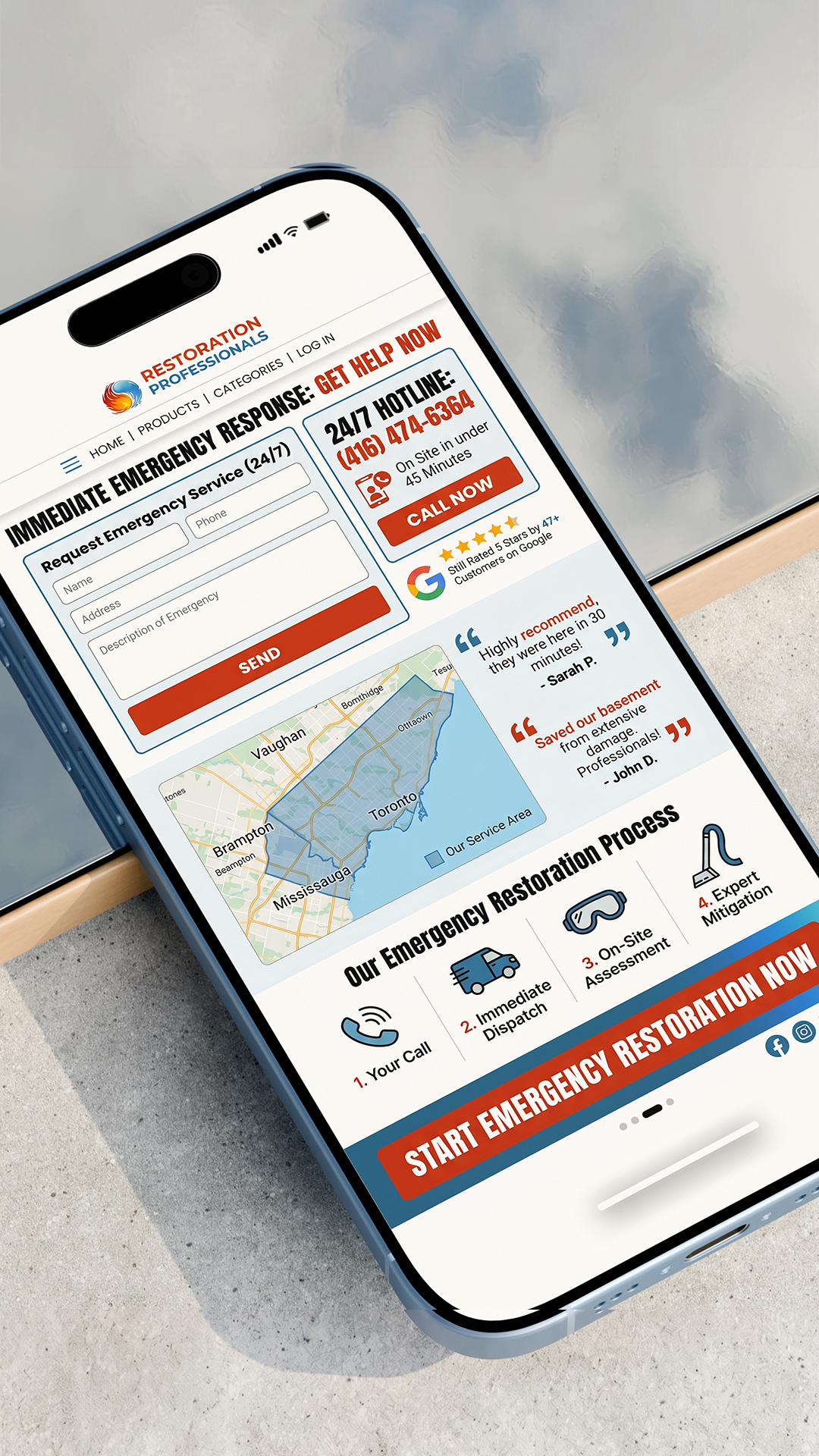
Restoration buyers are not browsing for fun. They have a flood, a fire, or mould, and they are choosing in minutes. So the rebuilt pages answer the only questions that matter in that moment - can you come now, how fast, and can I trust you - before anything else. We added a lead form built for speed, rebuilt the landing and sign-in pages to convert instead of just exist, and put the hotline, the response window, and the trust markers where a stressed person sees them without scrolling. A site that ranks but does not convert is an expensive brochure.
The ads pay for themselves, in jobs and not leads
We took over the Google Ads at around $1,500 a month. That budget returns 15 to 20 booked jobs a month. Not leads, not form fills - booked restoration work. In a category where a single job can be worth thousands, that math is not close. We also got the account ranking through Google ad reviews, so the paid presence reinforces the trust the organic side is building. This is Google Ads judged the only way that counts: what a booked job costs, not what a click costs.
Meeting people where they now ask - Reddit and AI
When something floods at 2am, plenty of people no longer start on Google. They ask Reddit, or they ask ChatGPT. So part of the current work is a genuine presence in both: an honest Reddit strategy in the threads where restoration actually gets discussed, and the structural work that gets Restoration Professionals surfaced when someone asks an AI who to call. Reddit ranks in Google and feeds the models AI answers are built from, so this is not a side quest - it is AI search done through the doors people already walk through. We launched Instagram and Facebook to round out the brand.
Why this one worked
Nothing here was a trick. We removed what was hurting the site, rebuilt it to be read and to convert, put a real budget behind ads that return real jobs, and grew the rest at a pace that holds. For a high-ticket emergency business the whole game is those three things at once - rank, convert, and a cost-per-job that clears the spend. If a restoration site is not doing all three, one of them is quietly leaking money.
Want work like this for your business?
Tell us what you sell and where you need more of it. We will come back with the most practical next step.